【解答・解説】東大理系数学2025 第3問

東京大学理系数学2025年 第3問

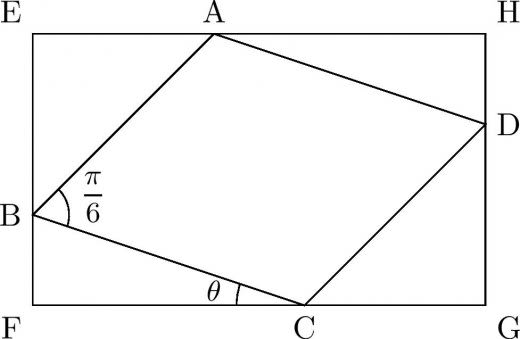
平行四辺形 ABCD\mathrm{ABCD} において,∠ABC=π6\angle \mathrm{ABC} = \dfrac{\pi}{6},AB=a\mathrm{AB} = a,BC=b\mathrm{BC} = b,a≦ba \leqq b とする。次の条件を満たす長方形 EFGH\mathrm{EFGH} を考え,その面積を SS とする。

条件:点 A\mathrm{A},B\mathrm{B},C\mathrm{C},D\mathrm{D} はそれぞれ辺 EF\mathrm{EF},FG\mathrm{FG},GH\mathrm{GH},HE\mathrm{HE} 上にある。

ただし,辺はその両端の点も含むものとする。

  1. ∠BCG=θ\angle \mathrm{BCG} = \theta とするとき,SS を a,b,θa,b, \theta を用いて表せ。
  2. SS のとりうる値の最大値を a,ba,b を用いて表せ。

この記事では東京大学理系数学第3問を解説します。

解答

(1)

比較的シンプルな計算問題からスタートです。

(1)

pic_hect

※ 図は不正確です!

△ABE≡△CGD\triangle \mathrm{ABE} \equiv \triangle \mathrm{CGD},△ADH≡△CBF\triangle \mathrm{ADH} \equiv \triangle \mathrm{CBF} であるため, S=平行四辺形ABCD+2△ABE+2△BCF S = \text{平行四辺形} \mathrm{ABCD} + 2\triangle \mathrm{ABE} + 2\triangle \mathrm{BCF} である。

平行四辺形ABCD=abcos⁡π3=12ab \text{平行四辺形} \mathrm{ABCD} = ab \cos \dfrac{\pi}{3} = \dfrac{1}{2} ab である。

∠ABE=π−π6−(π2−θ)=θ+π3\begin{aligned} \angle \mathrm{ABE} &= \pi - \dfrac{\pi}{6} - \left( \dfrac{\pi}{2} - \theta \right) \\ &= \theta + \dfrac{\pi}{3} \end{aligned} であるため, △ABE=12AE×BE=12acos⁡∠ABE×asin⁡∠ABE=a22sin⁡(2θ+23π)cos⁡(2θ+23π)=a24sin⁡(2θ+23π)\begin{aligned} \triangle \mathrm{ABE} &= \dfrac{1}{2} \mathrm{AE} \times \mathrm{BE} \\ &= \dfrac{1}{2} a \cos \angle \mathrm{ABE} \times a \sin \angle \mathrm{ABE}\\ &= \dfrac{a^2}{2} \sin \left( 2\theta + \dfrac{2}{3}\pi \right) \cos \left( 2\theta + \dfrac{2}{3}\pi \right)\\ &= \dfrac{a^2}{4} \sin \left( 2\theta + \dfrac{2}{3}\pi \right) \end{aligned} である。同様に △BCF=b24sin⁡2θ\begin{aligned} \triangle \mathrm{BCF} = \dfrac{b^2}{4} \sin 2\theta \end{aligned} である。

よって S=12ab+a22sin⁡(2θ+23π)+b22sin⁡2θ\begin{aligned} S &= \dfrac{1}{2}ab + \dfrac{a^2}{2} \sin \left( 2\theta + \dfrac{2}{3}\pi \right) + \dfrac{b^2}{2} \sin 2\theta \end{aligned}

(2)

三角関数の合成をして計算をします。ただし θ\theta のとり得る値の範囲は狭いことに注意しましょう。

(2)

S−12abS-\dfrac{1}{2} ab の部分を考えればよい。 S−12ab=a22sin⁡(2θ+23π)+b22sin⁡2θ=−a24sin⁡2θ+34a2cos⁡2θ+b22sin⁡2θ=(b22−a24)sin⁡2θ+34a2cos⁡2θ\begin{aligned} &S-\dfrac{1}{2} ab \\ &= \dfrac{a^2}{2} \sin \left( 2\theta + \dfrac{2}{3}\pi \right) + \dfrac{b^2}{2} \sin 2\theta\\ &= -\dfrac{a^2}{4} \sin 2\theta + \dfrac{\sqrt{3}}{4} a^2 \cos 2\theta + \dfrac{b^2}{2} \sin 2 \theta \\ &= \left( \dfrac{b^2}{2}-\dfrac{a^2}{4} \right) \sin 2\theta + \dfrac{\sqrt{3}}{4} a^2 \cos 2\theta \end{aligned}

ここで (b22−a24)2+(34a2)2=(2b2−a2)2+(3a2)242=4a4−4a2b2+4b216=a4−a2b2+b44\begin{aligned} &\left( \dfrac{b^2}{2}-\dfrac{a^2}{4} \right)^2 +\left( \dfrac{\sqrt{3}}{4} a^2 \right)^2\\ &= \dfrac{(2b^2-a^2)^2+(\sqrt{3}a^2)^2}{4^2}\\ &= \dfrac{4a^4-4a^2b^2+4b^2}{16}\\ &= \dfrac{a^4-a^2b^2+b^4}{4} \end{aligned} であるため, S−12ab=a4−a2b2+b42sin⁡(2θ+α) S - \dfrac{1}{2}ab = \dfrac{\sqrt{a^4-a^2b^2+b^4}}{2}\sin \left( 2\theta + \alpha \right) と表される。

ただし, cos⁡α=1a4−a2b2+b4(b2−a22)sin⁡α=1a4−a2b2+b432a2\begin{aligned} \cos \alpha &= \dfrac{1}{\sqrt{a^4-a^2b^2+b^4}} \left( b^2 - \dfrac{a^2}{2} \right)\\ \sin \alpha &= \dfrac{1}{\sqrt{a^4-a^2b^2+b^4}} \dfrac{\sqrt{3}}{2} a^2 \end{aligned} (−π2<α<π2)\left( - \dfrac{\pi}{2} < \alpha < \dfrac{\pi}{2} \right) である。

θ\theta の範囲を求める。 0≦∠ABF≦π20≦∠BCG≦π2 0 \leqq \angle \mathrm{ABF} \leqq \dfrac{\pi}{2}\\ 0 \leqq \angle \mathrm{BCG} \leqq \dfrac{\pi}{2} より 0≦θ+π3≦<π20≦θ≦π2 0 \leqq \theta + \dfrac{\pi}{3} \leqq< \dfrac{\pi}{2}\\ 0 \leqq \theta \leqq \dfrac{\pi}{2} であるため,0≦θ≦π60 \leqq \theta \leqq \dfrac{\pi}{6} である。

よって α≦2θ+α≦α+π3\alpha \leqq 2\theta + \alpha \leqq \alpha + \dfrac{\pi}{3} である。この範囲に π2\dfrac{\pi}{2} が含まれるかどうか調べよう。

α≦π2≦α+π3\alpha \leqq \dfrac{\pi}{2} \leqq \alpha + \dfrac{\pi}{3} を変形すると π6≦α≦π2\dfrac{\pi}{6} \leqq \alpha \leqq \dfrac{\pi}{2} となる。 cos⁡\cos を当てはめると, 0≦1a4−a2b2+b4(b2−a22)≦32 0 \leqq \dfrac{1}{\sqrt{a^4-a^2b^2+b^4}} \left( b^2 - \dfrac{a^2}{2} \right) \leqq \dfrac{\sqrt{3}}{2} となる。b≧ab \geqq a であることから,左の不等式は成り立つ。

右の不等式の検討をする。 3(a4−a2b2+b4)4−(b2−a22)2=12a4+14a2b2−14b4=14(2a2−b2)(a2+b2)\begin{aligned} &\dfrac{3(a^4-a^2b^2+b^4)}{4} - \left( b^2 - \dfrac{a^2}{2} \right)^2 \\ &= \dfrac{1}{2}a^4 + \dfrac{1}{4}a^2b^2 - \dfrac{1}{4} b^4 \\ &= \dfrac{1}{4} (2a^2-b^2)(a^2+b^2) \end{aligned} であるため, 1a4−a2b2+b4(b2−a22)≦32  ⟺  2a2−b2≧0\begin{aligned} &\dfrac{1}{\sqrt{a^4-a^2b^2+b^4}} \left( b^2 - \dfrac{a^2}{2} \right) \leqq \dfrac{\sqrt{3}}{2}\\ \iff & 2a^2-b^2 \geqq 0 \end{aligned} となる。

  • 2a≧b\sqrt{2} a \geqq b のとき

最大値は 2θ+α=π22\theta + \alpha = \dfrac{\pi}{2} のとき,つまり θ=π4−α2\theta = \dfrac{\pi}{4} - \dfrac{\alpha}{2} のとき, 12ab+a4−a2b2+b42 \dfrac{1}{2}ab + \dfrac{\sqrt{a^4-a^2b^2+b^4}}{2} を取る。

  • a≦b\sqrt{a} \leqq b のとき

最大値は 2θ+α=α+π32\theta + \alpha = \alpha + \dfrac{\pi}{3},つまり θ=π6\theta = \dfrac{\pi}{6} のとき, 12ab+a22sin⁡π+b22sin⁡π3=12ab+34b2\begin{aligned} &\dfrac{1}{2} ab + \dfrac{a^2}{2} \sin \pi + \dfrac{b^2}{2} \sin \dfrac{\pi}{3}\\ &= \dfrac{1}{2}ab + \dfrac{\sqrt{3}}{4} b^2 \end{aligned} を取る。

計算が重たい……。まさに東大の第3問といったところでしょうか。